
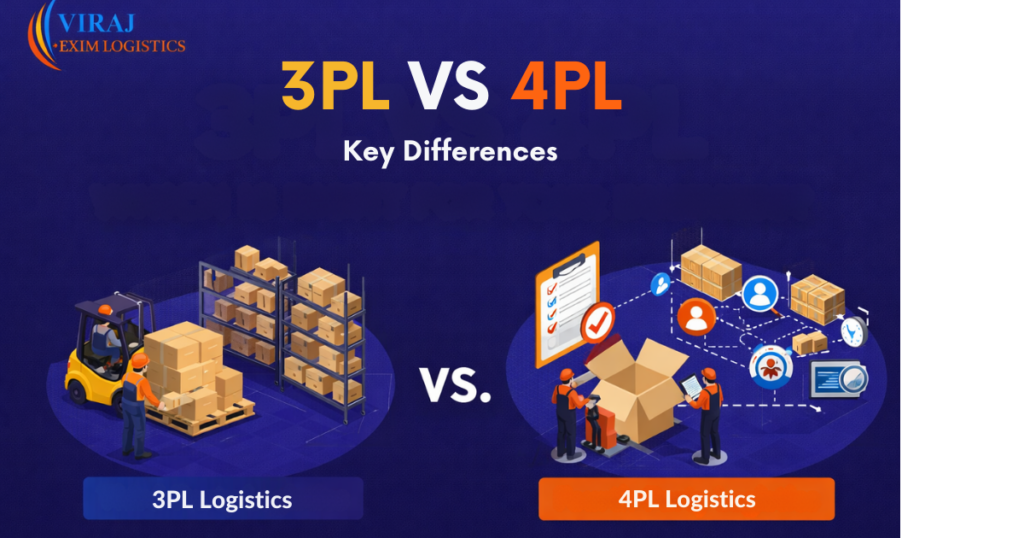
In today’s fast-paced global economy, businesses face constant pressure to deliver products quickly, cheaply, and efficiently. Many companies find it impractical to manage logistics in-house. This is why logistics outsourcing is now a key part of modern supply chains. Two of the most common outsourcing models are 3PL Logistics and 4PL Logistics.
While both play critical roles in transport and logistics management, they serve very different purposes. Understanding the differences between 3PL and 4PL can help businesses choose the right logistics strategy. This can improve efficiency and enhance supply chain management.
This guide breaks down the definitions, services, advantages, and use cases of 3PL and 4PL in a simple, practical way.
Logistics outsourcing means hiring outside companies to manage some or all of a business’s supply chain tasks. These services can include transportation, warehousing, inventory management, technology integration, and strategic planning.
Among the different models, Third-Party Logistics (3PL) and Fourth-Party Logistics (4PL) are the most popular. Many growing and large businesses use them.
3PL stands for Third-Party Logistics, in which a business outsources specific logistics functions to an external provider. These providers focus on execution-based services rather than complete supply chain control.
In simple terms, 3PL Logistics helps businesses move, store, and distribute goods efficiently without having to manage everything in-house.
Most 3PL Companies specialize in operational logistics activities, such as:
These 3PL services let companies focus on sales, marketing, and product development.
Meanwhile, the logistics partner handles daily operations.
3PL is ideal for:
Businesses that want operational efficiency without giving up strategic control often find 3PL to be the perfect balance.
4PL stands for Fourth-Party Logistics. Unlike 3PL, a 4PL provider does not just execute logistics tasks. Instead, it manages and oversees the entire supply chain on behalf of the client.
A 4PL Logistics provider is a single point of contact. It coordinates many 3PLs, technology platforms, and suppliers. This helps deliver complete logistics solutions.
4PL Companies focus on strategy, integration, and optimization rather than solely on physical transportation. Their responsibilities often include:
A 4PL partner functions more like a logistics architect than an operator.
4PL is best suited for:
Organizations that want a strategic partner rather than just a service provider typically choose 4PL.
Understanding the difference between 3PL and 4PL becomes easier when comparing their roles directly.
Both models contribute significantly to supply chain optimization, but in different ways.
The choice depends on whether a business needs operational support or strategic transformation.
When deciding between 3PL and 4PL, businesses should evaluate:
Many companies even start with 3PL and transition to 4PL as they scale.
As global trade grows more complex, the demand for advanced logistics management services continues to rise. Digital transformation, AI-driven forecasting, and real-time tracking are pushing logistics providers to evolve beyond traditional models.
Both 3PL and 4PL are important, but more businesses are choosing 4PL. This is because 4PL offers better long-term efficiency and resilience.
Viraj Exim Logistics is a trusted name in the logistics industry. We offer reliable, efficient, and growth-focused solutions. The company is dedicated to excellent service. We provide tailored logistics solutions to meet the changing needs of today’s businesses.
Viraj Exim Logistics specializes in comprehensive freight forwarding, supply chain coordination, and professional logistics support, helping businesses streamline operations and improve delivery performance. Our skilled team knows the challenges of both local and global logistics. This makes them a reliable partner for businesses of any size.
Viraj Exim Logistics is one of the top logistics companies in India. We use their industry knowledge to provide customer-focused solutions. This helps support smooth trade and effective supply chain management.
Knowing the difference between 3PL and 4PL logistics is essential. This knowledge helps create an efficient, scalable, and future-ready supply chain. While 3PL focuses on execution and operational efficiency, 4PL delivers strategic oversight and end-to-end management.
Choosing the right logistics partner can change your supply chain from a cost center to a competitive advantage. With experienced providers like Viraj Exim Logistics, businesses can confidently move toward better logistics solutions.
1. What is the main difference between 3PL and 4PL logistics?
The main difference between 3PL and 4PL logistics lies in their scope of responsibility. 3PL logistics focuses on executing specific logistics services such as transportation, warehousing, and order fulfillment. In contrast, 4PL logistics manages the entire supply chain, including overseeing multiple 3PL providers, technology platforms, and strategic planning.
2. What does 3PL mean in logistics?
3PL stands for Third-Party Logistics. This is when businesses hire outside companies to handle shipping, storage, and distribution. This allows companies to reduce operational burden and improve efficiency without managing logistics internally.
3. What does 4PL mean, and how is it different from 3PL?
4PL stands for Fourth-Party Logistics. A 4PL provider is different from a 3PL provider.
A 4PL acts as a supply chain integrator. It manages logistics strategy, coordination, and optimization. This is done across the entire supply chain, not just individual logistics tasks.
4. Which is better: 3PL or 4PL logistics?
Neither is universally better—it depends on business needs. 3PL logistics is excellent for companies that need support and flexibility. In contrast, 4PL logistics is better suited to large or complex businesses. These businesses need complete supply chain management and strategic oversight.
5. What services are offered by 3PL companies?
Most 3PL companies offer services such as transportation management, warehousing, inventory control, order fulfillment, freight forwarding, and customs clearance. These services help businesses streamline logistics operations efficiently.
6. What services do 4PL companies provide?
4PL companies offer complete logistics management services. These include supply chain design and coordinating different logistics partners. They also monitor performance, optimize costs, and use advanced analytics for ongoing supply chain improvement.
7. How do I choose the right logistics service provider for my business?
Choosing the right logistics service provider depends on your business size, supply chain complexity, growth plans, and budget. Businesses with simple logistics needs often benefit from 3PL. Companies with complex or global operations may need 4PL solutions.