
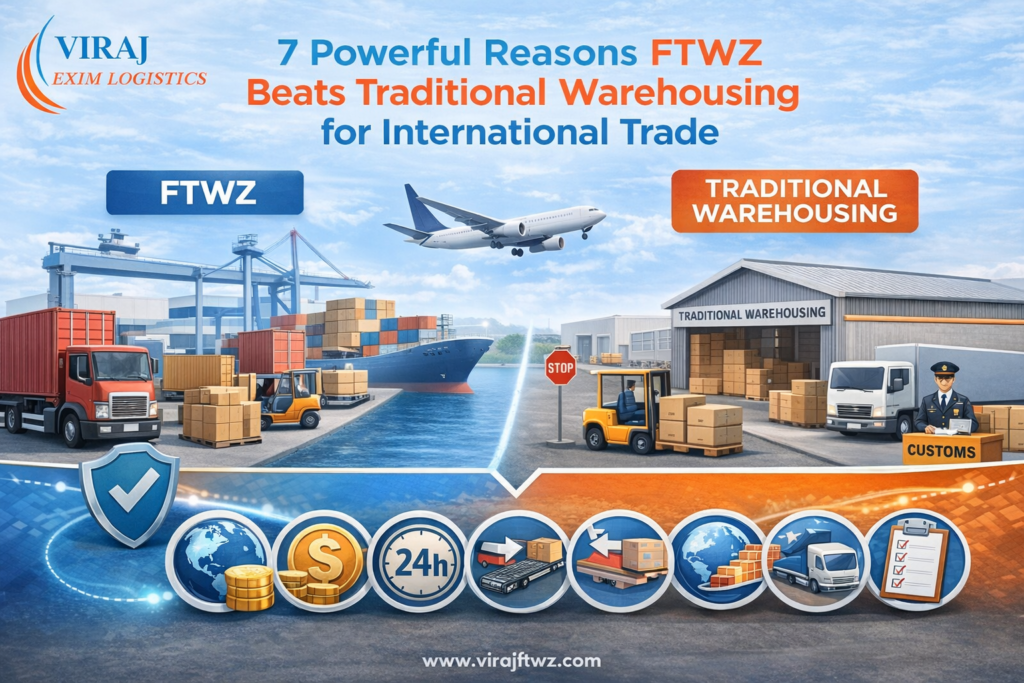
International trade is not just about moving goods from one country to another. It’s about managing costs, handling customs, protecting cash flow, and delivering on time, all at once.
Many businesses still rely on traditional warehousing models, only to realize later that duties, delays, and compliance complexities are silently eating into their profits.
This is where Free Trade Warehousing Zones (FTWZ) are transforming the way global trade works. More than just storage spaces, FTWZ facilities are strategic trade hubs designed to reduce costs, improve flexibility, and give businesses a serious competitive edge.
One of the biggest advantages of FTWZ over traditional warehousing is customs duty deferment.
This creates a massive cash flow advantage, allowing businesses to:
For high-value products, this difference alone can significantly impact profitability.
This cash flow benefit is just one of the major advantages discussed in our detailed breakdown of Top 10 Benefits of Using a Free Trade Warehousing Zone for Your Global Supply Chain.
Time is money in international trade. Delays at ports and customs can disrupt supply chains and damage customer relationships.
FTWZ operates under a special customs-bonded zone framework.
This ensures:
For businesses dealing in global supply chains, this speed becomes a competitive differentiator.
Many global businesses use India (or other countries) as a distribution hub for regional markets.
In traditional warehousing:
In FTWZ:
This makes FTWZ ideal for:
FTWZ transforms the country into a strategic global redistribution center.
Traditional warehouses typically offer:
FTWZ facilities provide value-added services such as:
This means goods can be:
Instead of moving goods to separate facilities, businesses get integrated logistics solutions, saving time and operational costs.
Traditional warehouses are often located inland, far from ports.
This causes:
FTWZ zones are strategically located:
Benefits include:
Location plays a critical role in global trade efficiency, and FTWZ wins here decisively.
Traditional warehousing often forces businesses to:
With FTWZ:
This allows:
For industries like electronics, automotive, pharmaceuticals, and consumer goods, this flexibility directly improves operational efficiency.
FTWZs are designed to attract international trade and foreign investment.
Unlike traditional warehousing structures, FTWZ offers:
For global companies, this means:
This makes FTWZ a highly attractive option for multinational corporations looking to establish a regional base.
While we’ve discussed how FTWZ outperforms traditional warehousing, you can also explore the broader strategic advantages in our detailed guide on Top 10 Benefits of Using a Free Trade Warehousing Zone for Your Global Supply Chain, where we explain how FTWZ strengthens overall supply chain performance.
| Feature | Traditional Warehouse | FTWZ |
| Duty Payment | Immediate | Deferred |
| Re-export Benefit | Limited | Full duty exemption |
| Customs Process | Regular | Simplified |
| Value-Added Services | Basic | Advanced |
| Strategic Location | Varies | Near ports/airports |
| Cash Flow Impact | High blockage | Optimized |
| Global Distribution Hub | Limited | Highly suitable |
FTWZ is ideal for:
If your business deals with international shipments regularly, FTWZ is not just an option, it is a strategic necessity.
If your business falls into any of these categories, partnering with an experienced FTWZ operator like Viraj FTWZ can help you streamline imports, optimize duty management, and scale global distribution efficiently.
Modern businesses need:
FTWZ provides all these advantages in one integrated ecosystem.
In contrast, traditional warehousing models were not built for today’s global trade complexity. They lack flexibility, financial efficiency, and strategic advantages required for cross-border operations.
International trade is becoming more competitive, more cost-sensitive, and more time-driven than ever before. Businesses that choose smarter logistics structures naturally gain an advantage over those still operating on traditional models.
Free Trade Warehousing Zones are not just large storage facilities, they function as strategic trade enablers that directly improve how global operations run. With benefits like duty deferment, faster customs processing, seamless re-export options, value-added services, strategic port-based locations, flexible inventory management, and investor-friendly policies, FTWZ offers a clear edge over traditional warehousing systems.
For companies looking to expand into international markets, protect working capital, reduce operational costs, and build a more agile supply chain, moving to an FTWZ model can be one of the most practical and profitable logistics decisions they make.